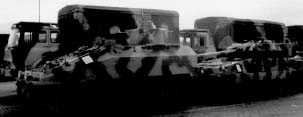
 consists of a
sloping beach and sand-dunes it at once conjured up ideas of amphibious
warfare.
consists of a
sloping beach and sand-dunes it at once conjured up ideas of amphibious
warfare.Browndown is on the southern coast of England, a few miles west of Gosport
and close to Portsmouth. The long coach journey from Stranraer was justified
by the quality of the new training available at Browndown. As one of the
training areas is next to the Camp and consists of a
sloping beach and sand-dunes it at once conjured up ideas of amphibious
warfare.
And so, with the support of 17 Port and Maritime Regiment at Marchwood and the Camp staff at Jersey Camp on the Isle of Wight, all the training at camp was aimed towards the final exercise which concluded with a beach landing from military landing craft.
The Main Party arrived at Camp in time for an evening meal and, after a briefing session were able to sort out their kit, sent ahead with the Advance Party and then have a very necessary night's sleep before commencing the training programme next day. Operating in three platoons, the cadets undertook four day's training which included weapon safety, field craft, battle drills, static attack techniques, boarding and exiting landing craft, first aid, map-reading and live firing on the Royal Navy range at Tipner. We were privileged to have a training team of 12 NCOs from 3 Royal Irish to set up and run the various training stands. Sergeant Major John Hunsdale and his men did a marvellous job and, knowing our officers and senior NCOs from previous training and field days, they were able to include them in the training programme so that everyone on training was employed meaningfully.
Each morning started with the now traditional battle physical training before breakfast. This year there was a variety of types of physical training which included the splendid new indoor games facilities. The cadets' food, provided by Pall Mall Caterers, was of a good standard and cadets had their own canteen in the evenings where hot snacks augmented the usual diet of sweets and soft drinks.
By the end of Day Four all cadets were ready for the exercise, and briefing
sessions were held. First of all, Officers, Training Staff and  Senior
Cadet NCOs were briefed in general by the Commanding Officer and then warning
orders were given by the Cadet RSM John Taylor to the Platoon Officers and
CSMs. They in turn briefed their platoon and section commanders and eventually
all cadets were thoroughly put in the picture. The Q.M. department provided
all the kit needed and the well-oiled performance of RQMS Andrew Mottram
and his team was much appreciated. Then the three platoons, Barrosa, Somme
and Korea boarded their four tonners and landrovers and the convoy set out
for the Portsmouth Ferry Terminal. After 30 minutes crossing to the Isle
of Wight and a twenty minute drive the platoons arrived at the staging post
in Jersey Camp. Here the advanced party issued weapons and blank ammunition,
packs were re-organised and webbing tightened and, in a very short time,
the advance to contact began. Two platoons were soon under fire from a well
positioned enemy and the third platoon finding their route barred by a tidal
inlet in full flood, set about building improvised rafts and attempting
to paddle to the other side. This was made difficult by harrowing fire from
a gun boat which appeared at irregular intervals to strafe the beach.
Senior
Cadet NCOs were briefed in general by the Commanding Officer and then warning
orders were given by the Cadet RSM John Taylor to the Platoon Officers and
CSMs. They in turn briefed their platoon and section commanders and eventually
all cadets were thoroughly put in the picture. The Q.M. department provided
all the kit needed and the well-oiled performance of RQMS Andrew Mottram
and his team was much appreciated. Then the three platoons, Barrosa, Somme
and Korea boarded their four tonners and landrovers and the convoy set out
for the Portsmouth Ferry Terminal. After 30 minutes crossing to the Isle
of Wight and a twenty minute drive the platoons arrived at the staging post
in Jersey Camp. Here the advanced party issued weapons and blank ammunition,
packs were re-organised and webbing tightened and, in a very short time,
the advance to contact began. Two platoons were soon under fire from a well
positioned enemy and the third platoon finding their route barred by a tidal
inlet in full flood, set about building improvised rafts and attempting
to paddle to the other side. This was made difficult by harrowing fire from
a gun boat which appeared at irregular intervals to strafe the beach.
Eventually all objectives were achieved and, after well earned compo meals, the platoons set up their bivvy areas and settled in to night routine. A few fighting patrols by the enemy kept the sentries on their toes but sooner than most cadets appreciated, it was time for a quick breakfast, a repack of kit and equipment and a forced march to the beach. Apparently Browndown Camp had been attacked and the mess waitresses were being held hostage in the beach fortress.
A landing craft was called up and quickly the three platoons boarded
and, after a forty-five minute voyage they approached Browndown beach. With
covering fire provided by local resistance and under coloured smoke the
attacking force hit the beach in good order and, 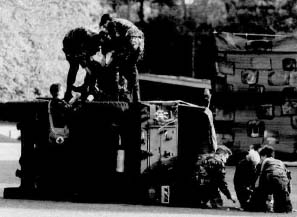 using fire and
movement, quickly breached the fortress defences, defeated the enemy and
released the hostages. After the mandatory declaration had been made the
exercise ended and everyone went for a very welcome shower and second breakfast.
The success of the exercise indicated clearly that the initial training
had been absorbed by the cadets and was a fitting conclusion to a very satisfactory
camp.
using fire and
movement, quickly breached the fortress defences, defeated the enemy and
released the hostages. After the mandatory declaration had been made the
exercise ended and everyone went for a very welcome shower and second breakfast.
The success of the exercise indicated clearly that the initial training
had been absorbed by the cadets and was a fitting conclusion to a very satisfactory
camp.
This camp would not have been possible and certainly not as successful without the assistance given by members of 3 Royal Irish, 5 Royal Irish, Queen's UOTC, 204 General Hospital (T.A.) and 254 Provo. Company (T.A.). Once again we introduced new aspects of military life and new equipment for cadets to use. This was due mainly to the continued hard work and imagination of WO1 Eugene French. What will he come up with for Kinmel Park 1998?


