Postcards from Scotland by Ogilvies
13) Edinburgh,
city, administrative center of Lothian Region, capital of Scotland, on the
southern shore of the Firth of Forth. Edinburgh is the second largest city in
Scotland, after the industrial center of Glasgow. It is, however, Scotland's
financial, cultural, educational, and service-industry hub. Among the city's
manufactures are paper, whisky, electrical and electronic equipment, food
products, and chemicals. The printing and publishing industry was well
established here by the 16th century. Edinburgh's port, at the communities of
Leith and Granton, is a major service point for vessels associated with the
North Sea petroleum industry. The principal imports are petroleum products,
grain, ores, and wood; exports include whisky, steel, and fertilizer. The city
is also one of the major tourist centers of Great Britain.
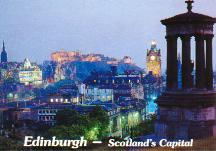 Edinburgh's
central dominating landmark is Edinburgh Castle, rising on sheer cliffs above
the city. Located here is the 11th-century Chapel of Saint Margaret, the city's
oldest structure. The Castle Rock is connected to the 16th-century royal
Scottish residence of Holyrood Palace by a road known as the Royal Mile, the
main thoroughfare of the Old Town district of the city. Other notable buildings
in Old Town include Saint Giles, the National Church of Scotland (largely 15th
century); the Parliament House, seat of the Scottish Parliament from its
completion in 1639 until 1707; and the house of the 16th-century Protestant
reformer John Knox. To the north of this district is New Town, which was
developed in the late 18th century and contains many fine buildings designed by
the Scottish architect Robert Adam. Separating the two districts is Princes
Street Gardens, occupying the bed of a loch that was drained in 1816.
Edinburgh's
central dominating landmark is Edinburgh Castle, rising on sheer cliffs above
the city. Located here is the 11th-century Chapel of Saint Margaret, the city's
oldest structure. The Castle Rock is connected to the 16th-century royal
Scottish residence of Holyrood Palace by a road known as the Royal Mile, the
main thoroughfare of the Old Town district of the city. Other notable buildings
in Old Town include Saint Giles, the National Church of Scotland (largely 15th
century); the Parliament House, seat of the Scottish Parliament from its
completion in 1639 until 1707; and the house of the 16th-century Protestant
reformer John Knox. To the north of this district is New Town, which was
developed in the late 18th century and contains many fine buildings designed by
the Scottish architect Robert Adam. Separating the two districts is Princes
Street Gardens, occupying the bed of a loch that was drained in 1816.
Among Edinburgh's cultural institutions are the National Gallery of Scotland
(1859), the Scottish National Portrait Gallery (1882), the Royal Scottish Museum
(1854), and museums of modern art and Scottish history. The Edinburgh
International Festival, held here annually since 1947, is a world-renowned arts
festival. The University of Edinburgh (1583) is especially noted for its schools
of medicine and law. Other educational institutions include Heriot-Watt
University (1821), Edinburgh College of Art (1907), and colleges of
architecture, technology, education, and theology.
Castle Rock was occupied by the Picts about the 6th century AD. In the 11th
century Malcolm III, king of Scotland, had his castle here, and his wife, St.
Margaret, built a small church. King Robert Bruce granted Edinburgh a charter in
1329. The town became (1437) the national capital following the murder of James
I, king of Scotland, at Perth, the former capital. Edinburgh lost much of its
commercial and administrative importance in 1603 when James VI became James I,
king of England, and departed for London. By the Act of Union with England
(1707), the Scottish Parliament was dissolved. Edinburgh's expansion beyond its
medieval boundaries to New Town was planned by the town council in 1767. During
the 18th and 19th centuries the city flourished as a cultural centre; it was the
home of, among others, the writers Robert Burns, James Boswell, and Sir Walter
Scott and the philosophers Adam Smith and David Hume. The city's boundaries were
expanded considerably in 1856 (when New Town was absorbed), 1900, and 1920.
Before 1975 Edinburgh was the county town of the former county of Midlothian.
Population (1991 preliminary) 421,213.