Postcards from Scotland by Ogilvies
15) 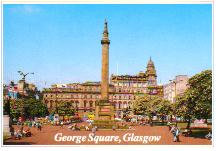 Glasgow.
City
and administrative center of Strathclyde Region, western Scotland, on the River Clyde. Glasgow is the largest city and leading industrial
centre of Scotland. It
has an excellent harbour and modern port facilities. Major imports include
petroleum, grain, and timber; exports are largely manufactured goods.
Industries include shipbuilding (to a lesser extent now) and printing and the manufacture of
textiles, carpets, aircraft engines, electronic equipment, chemicals, alcoholic
beverages, and processed foods.
Glasgow.
City
and administrative center of Strathclyde Region, western Scotland, on the River Clyde. Glasgow is the largest city and leading industrial
centre of Scotland. It
has an excellent harbour and modern port facilities. Major imports include
petroleum, grain, and timber; exports are largely manufactured goods.
Industries include shipbuilding (to a lesser extent now) and printing and the manufacture of
textiles, carpets, aircraft engines, electronic equipment, chemicals, alcoholic
beverages, and processed foods.
Relatively few buildings in Glasgow predate the 18th century; the most
prominent of these are Saint Mungo's Cathedral (begun about 1136 and completed
in the mid-15th century) and Provand's Lordship (circa 1471), the city's oldest
house. Glasgow is an educational center; the University of Glasgow (1451), the
University of Strathclyde (1796), the Royal Scottish Academy of Music and Drama
(1847), Glasgow School of Art (1845), and several technical colleges are located
here. The extensive collections of the Glasgow Museums and Art Galleries are
among the finest in Great Britain. Also of note in the city are the Hunterian
Museum (1807), the Botanic Gardens, and Calderpark Zoo.
Glasgow grew around a church built in the mid-6th century by St. Kentigern
(also called St. Mungo), apostle to the Scots. In 1116 the town's church was
rebuilt for the reconstituted Episcopal see of Glasgow. The great commercial
growth of the community dates from the union of Scotland with England in 1707.
Glasgow obtained a large share of the American commerce and soon became a center
of the tobacco trade. The river was dredged to accommodate seagoing vessels. The
tobacco trade ceased as a result of the American Revolution and was subsequently
supplanted by cotton textile manufacture and the sugar trade with the West
Indies. In the early 19th century, Glasgow began its growth as a major iron
founding and shipbuilding center. During World War II the city suffered serious
damage from German bombing. Slum clearance and urban redevelopment projects have
been undertaken since the war. Population (1991 preliminary)
654,542.