 |
The Masks of SentinelChapter One(part 1 of 3) |
|
The Masks of SentinelChapter One(part 1 of 3) |
A copper flame in the sunlight, the hawk lifted free of
the ship and headed landward. Horizons fell back as it
climbed the offshore wind. Its questing eyes scoured the
blue-green sky, the reflected shimmer of the bay, then
probed the sequence of earth tones beyond: castle, plain,
forest, mountains. At the limit of focus, white peaks
blazed under the edge of Sentinel's night.
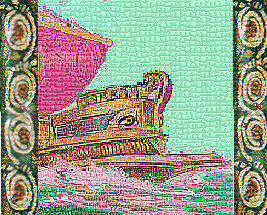
Purple lateen sail and tiger-striped pennant proclaimed
the ship's far south origin; generous lines and single banks
of oars marked it a merchantman. Sun and salt had bleached
to red-coral the once proud crimson paintwork. A ram
projected from the prow; above it, gilded eyes stared
blindly at an unfamiliar shore.
The vessel was the Kuthnar. It lay at anchor
between two monumental pillars of silver-veined crystal.
Taller than any tower of stone or iron, their summits
appeared fused to the sky. Unscarred by time and storm,
they resisted even the colours of the swollen, fiery sun.
Their purpose was entirely unknown.
A suggestion of perversity haunted the galley's
location. Framed by twin artifacts of an age-lost
civilisation, it appeared trapped, crushed, an ill-fated
sport of nature. The Kuthnar had not been so anchored
at its captain's desire, but at the whim of its lone
passenger.
They stood, captain and passenger, on the foredeck. A
wolf lay in front of them, its powerful tawny shape redolent
of the white far north. All three followed the flight of
the hawk.
Anxious to rid himself of his troublesome charge and set
course for home, the captain diverted his gaze, noting the
sun's position and the sail's tautness. "It's well past
noon," he said cautiously. "Do you plan to disembark?"
Keeping his eyes fixed on the hawk, now little more than
a black fleck in the sky, the other smiled faintly, and
murmured, "A decision, Tarush, is ... beyond me at present.
However, the signs are promising."
"I assume, then - "
Hackles bristling, the wolf growled.
Not daring to press the point, Tarush sighed resignedly
and contemplated the deck. Of medium height, broad and
strongly knit, he was the true essence of the ship made
flesh. Every visible part called to mind the sun, the
ocean, the south: mahogany skin; raven-black hair, drawn
tight, knotted at the neck; eyes like glazed terracotta;
hooked nose; mouth wide and full; luxuriant beard strung
with beads of red faience. He wore a plain kirtle of faded
murex blue cloth, gathered in at the waist by a plaited
leather belt.
Tarush lifted his head abruptly as something bright
dangled near his face - a white blur shot with colour. The
passenger had raised his arm unnoticed; beneath his rigid
hand, a silver disk jerked at the end of a silver chain,
then assumed a gentle, pendulate motion.
"An astrolabe, captain."
"It's beautiful," Tarush whispered. "An astrolabe? The
name means nothing. And its purpose is beyond my reckoning.
It looks like a fabulous toy - a plaything for princes."
"The order of your responses pleases me. Take it.
Examine it closely."
Tarush received the object into his hands. It was
clearly no mere ornament. The disk was marked with
geometric designs and curious glyphs, richly overlaid with
calibrated wheels and jewelled cogs. He touched a tiny
lever ... and marvelled as the entire mechanism flowed at
once with patterns too complex for his mind to grasp.
"Its purpose, captain, is to determine a ship's position
by reference to the night sky."
Tarush laughed nervously. "Impossible. The
starsea in summer, the darksea in winter ....
An admirable conceit, though."
"Impossible? So was I until we met." A long pause,
then: "Keep it, if it pleases you, as final payment for my
passage."
Stifling his incredulous thanks, Tarush looped the chain
through his belt. He would examine this cryptic treasure
more fully later. As to the passenger's equally cryptic
actions and words, these were typical and best ignored. He
turned and looked down into the well of the ship, where his
men were carrying out routine tasks or resting. All
appearing in order, he lifted his head. Immediately, the
crystal towers captured his unwary glance. Massive, yet
somehow ethereal, these constructs existed on the borderland
of time. He tried to imagine them crumbling and falling, as
all towers must. But he knew that they were beyond the
reach of death. And so he was afraid of them.
A jewelfish surfaced close by. It floated on the waves
like a gigantic opal. Although larger than the Kuthnar, the
creature was harmless, being no more than a membraneous
globe filled with phosphorescent gas. Tarush watched it
rise majestic from the sea, trailing long, fragile
tentacles. The wind carried it, a glowing cloud, towards
the cinnabar red horizon.
The hawk, meanwhile, drew near the land.
|
Sea blurred by amber haze, gulls with viridian plumage,
a modest fishing fleet, waves and reefs fluently
interlocked, long furrows of foam, an ochreous beach like a
hoofprint in the shore - the hawk flew level and sharp-eyed
over all, then dived as if to the kill.
The bay's pincer-curved headlands were cloaked with
foliage bright as green leather, streaked with yellow and
crimson; on each, ruined outworks, black and splintered like
burnt bamboo, showed above the trees.
Tall cliffs, red-gold in the sun, russet in shadow,
lined the bay; and rising out of these, castle ramparts,
pinned with five layers of hexagonal bronze plates.
Light flashed from the battlements as though from waves:
jointed armour catching the sun. Dazzled, the hawk trusted
to the wind, drifting beyond the dragon-wall and its
defenders.
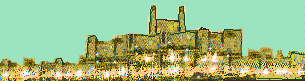
Through the fading blaze, an extensive settlement
gathered form, uniformly built of lion-coloured stone.
Unlike its enclosing wall, most of the inner castle was in a
poor state of repair. Only a series of carvings looked
recent, crusting barnacle-thick one of the more imposing
towers; closer inspection revealed these to be of faces - a
torrent of masks - many of unhuman aspect.
Signs of life were sparse for such a considerable
township. Most of the activity was concentrated in a large
square where a market appeared to be taking place. The
coloured pavilions and awnings, and the jostling crowds,
contrasted sharply with the tan stonework and predominant
stillness.
A massive central keep shouldered from the main sprawl.
Its design was plain, being no more than a cube of
undecorated masonry. Its walls were pierced with narrow
windows. It stood between two minarets that rose twice as
tall as itself. Swooping between them, the hawk flew beyond
the castle, beyond the sound of the sea.
Ruined buildings and crumbling walls littered the edge
of the landward fortifications. Then came a group of wattle
huts. Tar-painted boats, black and shining like
cockroaches, and nets hanging to dry, indicated a fishing
village. Beyond, a broad strip of farmland shelved into the
forested heart of the region.
The hawk flew on with fierce intentness. No movement
went unnoticed; nothing unusual was overlooked. Yet prey,
no matter how tempting, was deliberately ignored.
There was no hunger greater than that of the quest
....
One of Sentinel's moons burst like a bubble from the
seaward horizon. Steel blue, reflective, it flared red as
it hurtled into the light. Its speed slackened as it
crossed the sun, the lodestar. There was a brief eclipse,
during which the sky brimmed with flame-streaked darkness,
and gigantic shadows swept over sea and land. Then it
slowed to a halt, hanging well below the zenith.
The winged scout remained intent on the country beneath.
On the Kuthnar, however, the wolf stared fixedly at
the bright intruder. And Tarush said, "A moon of omen."
"I know little of these things," the passenger said.
"Explain."
"Surely everyone - Ah, yes, of course .... The moons -
they move fast or slow, appear singly or in groups. I
myself have seen as many as seven at one time, and have
heard claims of a dozen or more. They can change colour,
form patterns, spit fire like dragons."
"I see. And this omen - for good or ill?"
"That I can't say. It's the deepest of mysteries. Many
have claimed the knowledge, but none have survived for long.
An astrologer is only as good as his last prediction. I
heard of one who sold his services as an auger of moons to a
king fond of practical jokes. After three false
predictions, this magister was provided with moving bodies
of a somewhat more vital nature."
"I acknowledge the pause for effect."
"Scorpions in his bed."
A steady air-current held the hawk. Its keen eyes bored
through rippling heat and flickered over the earth. The
country beyond the fishing village was empty and still.
Wings snapped into life. The hawk shot forward until it
reached the forest wall. Waves of green woodland spread to
the shimmering horizon. Insect swarms clung to the foliage
in smoke-blue trails. There was an abundance of birdlife,
and hunger again stirred in the hawk; but it flew on.
A stone outcropping, grey and weatherworn, interrupted
the clear sweep of the forest roof. A suggestion of
unnatural form - four distinct faces; a series of levels,
tapering from the base - snared the hawk's attention.
Descending, it scanned the upper quarter of what was clearly
an artificial hill. The remains of a circular wall rested
like a hollow crown on the summit. Within this coronal of
broken masonry lay a great crystalline disk, resembling a
lake of ice: a convex surface, and a pale green bloom,
implied a glass lens of massive manufacture. Deep fissures
in the crumbling ashlar beneath the summit revealed a
cylindrical core of untarnished metal. It was apparent that
the now-ruined pyramidal structure had been added during a
later, degenerate age.
Circling and diving, the hawk left no accessible part of
the stone pile unseen. Then, climbing on the currents of
the summer wind, it returned to the sky.
And the gold-eyed hunter powered on, striking ever
deeper into unknown country.
Tarush shifted his gaze between the wolf and the moon,
undecided as to which fascinated him the most: the moon
itself, or the wolf's unbeastlike contemplation of it.
"This is the place I've been seeking."
Startled, Tarush turned towards the passenger. He
wondered if he had heard correctly. He glanced at the
other's face for some sign; but it was no more revealing
than the shining sphere that hung above them.
"Are you certain?" Tarush urged.
"I'm as sure as I can be. Prepare a boat. I'll go
ashore here."
"Then it's all over?" Tarush ventured. "We're free to
leave?"
"Aye. Did you hope this voyage would last forever?"
Laughter exploded from the galley-master. He turned and
looked down at his crew. Those closest by had already
sensed something was about to break, and rumour ran like
fire through the ship. Tarush gestured for silence. Within
moments, only the wash of waves and the creak of rigging
could be heard. Savouring every moment, Tarush stretched
anticipation to the limit. Finally, he pointed straight up
and shouted: "A moon of good omen! A voyage home, swift and
safe!" Then he made a hand signal: a caique would be
readied immediately.
A blaze of emotion - joy and relief mostly, though
sparked with residual anger and bitterness - filled the
ship. With months of uncertainty and disappointment
suddenly behind him, Tarush basked in it unashamedly. Then,
as it guttered into low, excited talk, he released a long
sigh and murmured, "A little theatricality never goes
amiss."
"Quite a performance, captain. You should consider the
stage."
Tarush moved to the passenger's side. "Thank you, but I
think not. A crew is more easily swayed than an audience,
and a shark less cruel than a critic."
"At least our particular play is almost over. I'm sorry
it turned out to be so frustrating for you and your men."
He raised his face to the sky once more. "But what scenes
are being written for us now, I wonder?"
Thought the galley-master: For the Kuthnar's
captain and crew, exit all, stage south, and no curtain
calls.
"But when and where was the prologue to this mad masque
enacted?"
Symos, the first mate, had worked his way to this
inevitable question by the third day of the voyage,
emboldened by the promptings of the crew and several drinks
beforehand.
Symbolically, Tarush had been absent-mindedly twisting
and knotting a length of rope at the time. To Symos's
surprise and relief, his mood had proved amenable and
candid. "You've the right to ask, the right to know."
Then, after sending for wine and taking a few reflective
sips, Tarush had started to tell the tale.
"It was the day we docked at Parthag-Arn. I met him at
The Inn of the Starsea Voyagers. My memory of the
encounter's somewhat vague, however...."
Symos had thought: A vintage yarn, then, in more ways
than one; but, wisely, had kept silent to the end.

Tarush had sailed to Parthag-Arn many times before. Yet
his first sight of it, by day or night, full on the horizon,
never failed to evoke a sense of wonder. From a distance,
it resembled a giant wave, frozen at its peak, hanging
between sea and sky. Closer to, however, the illusion
failed: the soft outlines of a wooded mountain became
apparent, with sheltering flanks sweeping out on either
side, and the main coastline clearly visible beyond. The
port itself sprawled over level foothills and thrust great
limbs out into the ocean.
Parthag-Arn was undoubtedly a superb natural harbour,
with a thriving environs. Yet what made the place unique
was the stone of the mountain's heart, from which all the
buildings and walls, causeways and breakwaters, were made.
There was no substance like it anywhere else on Sentinel.
It was quarried deep underground, and at first appeared
nothing more than white marble. But as it aged in the open,
it took on a curious, mystic quality: its surface shifted
chameleon-wise to match the prevailing mood of the hour and
the season. And the older the stone, the more supple its
response.
So it was that the harbour walls were crimson and gold
when the Kuthnar slid between them at dawn, and the
water they sheltered was like a lake of fire. A scent of
spicewood drifted out from beyond the waking town. Lighted
windows and hanging lamps darkened one by one. With a
profitable voyage just completed, Tarush had come to
Parthag-Arn in search of new cargo. He saw to it that the
Kuthnar was safely docked, then paid off the crew.
As soon as the last man had gone ashore, he secured and
sealed his ship, completed the necessary formalities with
the harbourmaster, and headed up into the town.
He followed ancient, winding, sun-dusted streets until
he came to the great bazaar of Parthag-Arn. This was one of
the finest and richest markets on Sentinel. Even its
awnings were made of the costliest cloths: it was often
referred to as the City of Silk. Most of the diverse and
colourful cultures of the planet met and mingled there.
Gaudy, noisy, pungent, hectic - after months at sea, Tarush
found the assault upon his senses almost painful. He soon
succumbed, however, and wandered for hour after hour, lost
in a magic maze under a shimmering rainbow sky.
At evening, Tarush tore himself away from the bazaar,
and took a palanquin to The Inn of the Starsea Voyagers.
This was an old, comfortable hostelry, a favourite haunt of
shipmen and merchants. The place was virtually empty when
Tarush arrived; he recognized no-one. After first arranging
his accommodation, he bought a jug of wine and settled
himself in a door-facing corner. As he drank, he let his
gaze wander over the murals that decorated the walls and
gave the inn its name. Some long-dead artist had tried to
imagine what kind of vessels might sail upon the starsea
were it indeed a watery ocean, and what manner of captains
might command them. Though faded with time and smoke, the
images were fantastic and beautiful.
As the evening wore on, others drifted in. Tarush was
keen to meet only with ship-masters already known to him; he
hoped to gain a commission for the Kuthnar but, for
some reason, was not in an outgoing frame of mind.
Time passed, and the space between Tarush's jealously
guarded two-man table and the door became crowded. There
were those who had come to laugh and drink, and those who
had come to talk and trade; none, except Tarush, seemed
alone.
He finished off his jug of wine, ordered another. He
knew that he was drinking too much, but had slipped into the
mood for it. Soon, the room began to swim a little, and
faces and voices became distant and dreamlike.
Some time later, he heard his name, shouted above the
din. But he never found out who it was that had recognized
him and called out to him. Even as he stared blearily into
the throng, the door of the inn burst open.
The starsea's silver light cut through the fireglow like
a wedge of ice. A tall, lean shape, swathed in black,
appeared in the entrance, paused a moment, then walked
straight in. Men moved out of his path, grumbling at the
intrusion. A big-bodied free-fighter, wearing the grey
cloak of the Guild of Mercenaries, ventured to block his
advance; then fell back with downcast eyes. Tarush saw a
narrow way open up in front of his table. The newcomer
moved like a wolf; his gaze was hawklike. Without asking,
without being asked, he sat opposite Tarush.
"Welcome," Tarush murmured, raising his glass. "You
remind me of someone," he went on, foolishly. "Must think."
His glance rested on one of the faded murals. "Of course."
He stared into eyes the colour of gold. "Starsea voyager."
"Not quite." A low voice, curiously accented. "But I
do need a ship. My name is Falk .... "
 Forward Forward
|