 |
The Masks of SentinelChapter One(part 3 of 3) |
|
The Masks of SentinelChapter One(part 3 of 3) |
Falk was not his given name. He had stolen it from a
thief he had surprised in an act of robbery. He could never
be sure that Falk had been the thief's real name; but it was
certainly the last syllable he had uttered before the wolf's
jaws had closed about his throat. It may have been that the
robber had cursed him, calling upon some god or demon to
avenge his death. To Falk, it was of no importance; he had
a name, as good as any. If he had ever had another, and he
supposed he must have, then it was as one with the rest of a
forgotten past.
Apart from a name, the thief had furnished Falk with
appropriate clothing and ornaments, valuables, weapons. Of
the latter, he had retained only the sword, for which he
felt an instinctive affinity - it seemed fitting to have a
hilt near his hand, even if the blade itself was rarely
needed.
Set beside Tarush, Falk was a giant, though economically
fleshed, and imbued with a tensile strength.
Fortunately, the thief had been roughly the same size as
himself. Personal taste, therefore, had not dictated his
choice of apparel: a sleeveless jerkin of black leather;
loose blackcloth trousers; calfskin boots, turned double
below the knee. Even when the opportunity had arisen, he
had not troubled to replace this clothing: like the name, it
fitted as good as any.
The adornments were few and barbaric in design. Falk
had never fully appreciated their purpose. He wore them
mainly because the thief had done so. Upon his wrists and
arms were bands of beaten silver, overlaid with complex
patterns in gold, set with semi-precious stones.
A golden torque hung about his neck.
His accoutrements comprised a brass-studded belt, and
the sword itself - its blade of fine-tempered steel, its
hilt of fluted ebony, its scabbard of leather cross-banded
with silver.
Both corpses - the thief's victim having lost his most
valuable possession before Falk's intervention - had
provided a substantial haul of currency and precious
objects. Falk had, by various means, converted most of this
into a minimum of high value tokens, which he stored in
pockets concealed in the lining of the jerkin.
Prior to this encounter, Falk's only belonging of any
material worth had been the silver astrolabe.
Falk's hair was yellow, hanging loose to his shoulders.
He was clean shaven; in fact, there was no trace of a beard
whatsoever. His skin was lightly tanned. His features were
regular and unremarkable - except the eyes, which shone with
the colour and hard brightness of gold metal.
A group of deep-cut scars on his chest, visible through
the loosely tied jerkin, formed a five-pointed star. The
patch of skin thus branded was smooth and shining like
silk.
(Tarush knew this symbol, and it disturbed him. It was
used in sorcery, and its name was Opener-Of-
Gates.)
With the final scene of the hunt still burning itself
into his brain, Falk struggled to focus on the captain's
broad, weather-beaten face. "Do you remember anything
else?"
Tarush shrugged. "It's a legend only. I can't even be
certain that this is the place of which it speaks. My chart
of this area shows only a country of considerable extent.
But there are no names, no cities inscribed, no detail of
mountains or rivers. Might as well be a desert from coast
to coast."
An early departure never far from his thoughts, the
ship-master paused to assess the condition of wind and
current. The elements provided him with an appropriate
metaphor.
"Think of time as an ocean," he said. "And think of
this planet Sentinel as a shore of that ocean. The tides of
past ages have left stranded much that is strange and
misunderstood - and feared. There are several regions piled
up with antique jetsam, and here is one of them. Such
places are sparsely populated, shunned by the rest of the
world."
"Antique jetsam," Falk repeated with a smile, clearly
taken with the phrase. "Curious that such wrecks of time
are less tarnished than the megaliths of the present."
"Aye. Witness these glass towers." And may the gods
pardon our presumption in challenging their right to this
patch of sea!
Falk recalled the lens-crowned hill in the forest. "A
great people must have fashioned these monuments."
"True. A race called, simply, The Makers, for
all that is really known of them is that they made things
... things both prodigious and perfect."
"And so The Makers are revered as demigods." It
was not a question.
"In some quarters," Tarush demurred. "Though whether as
deities or demons, patriarchs or archangels, The
Makers have found a place in most religions."
Falk nodded. "I lived for a time in the monastery at
Parthag-Arn. The philosophy espoused there was something of
a puzzle to me. Now it grows clearer."
This was one of the most revealing statements Falk had
ever made concerning his past, and Tarush ached to find out
more; but with his future, and that of his ship and men,
still balanced on the cusp of Falk's will, he decided not to
pursue the matter.
"At the monastery," Tarush said, "you'll have been
exposed to one of the more ascetic forms of worship; but
there are also cults of a more primitive nature, several of
which even maintain the practice of human sacrifice."
Falk saw again the head of the horned man, laying in the
trampled grass like a forked branch fresh-cut from a scarlet
tree. "Is there a sect that proclaims the hunting down of
men as a sacred ritual?"
Tarush frowned. "Never heard of - "
With a swiftness startling in a man of such bulk, Tarush
pulled his dagger from his belt and thrust it at the rail
beside him.
Red liquid jetted into the air, spattered onto the
deck.
Falk turned to look more closely. He saw the jewelled
blade, scintillating in the sun. Beneath it, pinned to the
wood, lay what looked like a pool of black slime. It was
roughly circular in shape, and of sufficient size to cover a
man's face.
As Falk watched, the thing convulsed, quivered, then
grew still. More of the crimson ichor oozed up around the
anlace point.
"Leech," Tarush grunted. He shivered involuntarily.
"Must've been carried over the sharkring by a high wave."
Falk nodded. The sharkring, he already knew, was a
ridge of razor-sharp spines of metal and glass, encircling
the Kuthnar's hull midway between oar-strake and
waterline.
"Perhaps the leech was attracted by our talk of
sacrifices," Falk murmured.
"Do you see any ears?" Reaching forward, Tarush pulled
his knife free, then flipped the dead creature back into the
ocean. After wiping the blood off on the rail, he held the
blade before his eyes.
"A messy sort of baptism," Tarush mused. "But it'll
do."
"With so much water available, your choice of fluid
seems perverse. But what does this ceremonial signify?"
"It's simple. This is a new weapon, as yet unnamed. I
bought it in the bazaar at Parthag-Arn. I've killed with
it, so must now name it."
"Leech, perhaps?"
"Seems inevitable, doesn't it?" He returned the blade
to its sheath.
"It does, though I haven't yet grasped the need for a
name."
"It's one of the Laws. Everyone knows the Laws. We
couldn't exist without them." Tarush could still be
disconcerted at the extraordinary gaps in Falk's
knowledge.
Falk said: "I believe I exist, therefore I exist. But
my memory's a little parched. Kindly refresh it."
"Well, the reasoning's straightforward enough," Tarush
responded. "The organic is superior to the inorganic. Men
are higher than animals, and animals higher than plants.
Gods are paramount. The lesser cannot destroy the greater.
Only life can take life. Everything that lives possesses a
name. Weapons kill. Weapons must be named."
"I see," said Falk. "But what of natural forces that
often kill with spectacular conviction - earthquakes, tidal
waves, avalanches?"
"In these circumstances, such forces become
supernatural. There are deities who move the earth and the
sea at will. And when an animal slays a man, it is
momentarily inhabited by some wilful spirit."
Falk laughed. "I should have guessed. So when my sword
steals a life, it becomes a temporary god!"
"Exactly."
"Then I name my sword ... Thief!"
Tarush nodded approvingly, though the reference to the
blade's previous owner was lost on him.
Falk turned away and looked up. A black fragment
detached itself from the starsea's edge. It sped across the
sky, passed from smoky purple to clear blue, then curved
beneath the oblate sun and descended towards the ship.
The hawk, returning.
"You should also name your ... companions," Tarush
suggested.
"Unnecessary," Falk replied. "But, for simplicity's
sake, and to satisfy your Laws, I will call them Wolf
and Hawk."
The galley-master restrained himself from asking which
was which.
Hawk plummeted through the invisible levels of the wind,
slowed as it neared the ship, sank past the straining sail,
extended talons, settled gently onto Falk's waiting fist.

Mist gathered over the sea, then flowed up the sky,
catching fire from the sinking lodestar. Before it, even
the crystal towers glowed red as the edges of a furnace
door.
Falk watched the caique that had brought them ashore
return to the waiting galley. Not long after, the ship,
black and vivid against the glare, turned and headed for the
mouth of the bay. As it sailed into the distance, the main
bulk of it dissolved into crimson vapour. The sail remained
in sight for a while, hanging like a tattered banner; then
it, too, was gone.
Carmine waves broke against the strand near to where
Falk stood. Hawk perched on his left shoulder. Wolf
crouched to his right, facing inland, keenly alert.
Falk viewed the Kuthnar's departure with some
sadness. It had been his home for a quarter-year. He had
grown to feel genuine companionship for its captain and
crew. There had been resentment, and the inevitable
misunderstandings, but only a single tragedy .... Two of the
men, seeking to cut short the voyage, had attacked Falk in
his cabin while he slept. One had lost a hand to Wolf, the
other an eye to Hawk. Falk chose to dwell on happier
memories.
He recalled his last words with Tarush. As the row-boat
had pulled away from the ship, the galley-master had
shouted: "By stormsnake and hellfire, I must know! You and
Wolf and Hawk. Who, what, are you?"
And Falk had answered, "One!"
Soon, the evening itself commanded all attention.
Sun and starsea generated conflicting tides of light,
throwing whirlpools of shade and colour over the world. A
quarter of the sky seemed to be on fire; the opposing
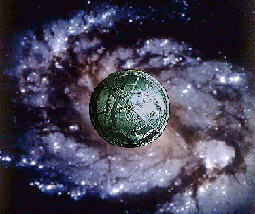
quarter was filled with the blazing heart of a galaxy; and a
vast web of luminosity spanned them, shot through with
flames of coral, purple and silver. The beach, in the
shadow of castle and cliff, was bluegrey; the sea-margins
were red like wine.
Dusk on Sentinel was always a time of splendour. But
Falk had never experienced one such as this. All of his
senses sang with it. Even the air tasted like some rare
vintage.
He lifted his face parallel to the sky, cutting off
vision of all save the sky itself. He stood like this for a
long while, satisfying some deep and unexplainable hunger.
A great red glow still hung over the ocean, though
perceptibly giving way to the stars. The stars,
tight-packed as grains of sand. The stars: for an
intoxicating moment, they appeared so close that he might
reach up, lucifer-like, and snatch a handful.
Falk knew the impossibility of mapping such a sky.
It rose and fell and circled through stages of infinite
variety. Even its discernible features, swirls and streams
of light and colour, were often obscured by disturbances in
the upper atmosphere. From Sentinel, the wheelwork of space
was so intricate, so complex, as to seem almost invisible.
This explained Tarush's reaction to the astrolabe - the
concept was completely alien, and his mind had snapped shut
against it.
The astrolabe. Now that he thought of it, Falk did not
understand why he had given it to Tarush. He had prized its
beauty. He had not been scornful of its intrinsic value.
It had been his only link with his lost past. And yet he
had parted with it as though it meant nothing to him. He
lowered his head and gazed at the stretch of water between
the two towers.
At the misty edge of the world, the lodestar smouldered
like lava.
A trumpet sounded: a single, held note, clean, piercing.
Wolf scanned for the source, but found nothing.
Intrigued, Falk turned away from the sea. Hawk
transferred to his hand, then winged up over the castle.
Walls gleamed like enamelwork in the variegated light. A
tall, cloaked figure stood in the crenellated summit of a
high tower. Two more notes were blown, identical to the
first. The ancient stones answered with a flock of echoes.
Three birds, whiter than salt, flew up from the shadows.
When the last sounds had died away, and all seemed still,
the trumpeter descended into the dark throat of the
tower.
Meanwhile, Falk considered the castle gate. He had
first noted it from the row-boat. A massive arch, twice as
high as a man, and easily as broad at the base, had been
gouged out of the cliff. This formed the mouth of a
colossal face, sculpted from the saffron rock. The carving
was obviously of great age, the features largely eaten away
by storm-wind and winter frost. Of the nose, little
remained beyond a ridged outline. The eyes were no more
than circular pits, positioned just below the
dragon-wall.
A solid bronze gate filled the arch. At its centre,
etched into the metal, was a symbol Falk recognised with a
quickening of blood: the five-pointed star. He reached up
and touched the scars on his chest. He started to walk
towards the doorway. Wolf went with him.
 As they passed into the shadow of the wall, Hawk
returned to Falk's right hand - a hand in no need of a
falconer's glove.
As they passed into the shadow of the wall, Hawk
returned to Falk's right hand - a hand in no need of a
falconer's glove.
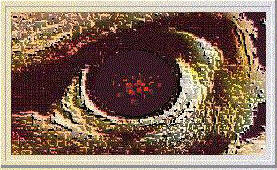
Within the gloomy recesses of the giant, snakelike eyes
above the gate, unseen lenses moved, sliding softly into new
positions; glinting like rubies in the red light streaming
from across the ocean, they focused on the golden tableau of
man, wolf and hawk.
 Forward Forward
|