 |
The Masks of SentinelChapter Three(part 2 of 2) |
|
The Masks of SentinelChapter Three(part 2 of 2) |
Light and colour pulsed and swirled through the
incense-misted hall.
A mood of expectancy hung heavy in the air, underpinned by
nervous whisperings and stifled laughter, the creaking of
leather and the rustling of brocade, the rasp of metal
against metal.
A trumpet sounded.
As one, all turned to face the heavy, ornate doors.
No-one entered.
Time passed.
The assembled throng grew restive.
Jewelled hems grazed the marble floor as courtiers turned
and bowed like mechanical figures in a clock-face pageant -
And they froze as if at the final chime when the doors flew
open and slammed back against the walls.
Overcoming shock, a group of priest-musicians began to
perform their sacred duty. Presently, however, the
cicada-like rattle of sistra and the brazen voices of gongs
could barely be heard above the tension-releasing shouts of
astonishment and anger.
A figure dazzling in jazerant of steel and white leather
towered in the entrance.
Thus did Starkad Frostmane come to the audience chamber of
Castle Erastor.
As the uproar and the music guttered, the Skarnyr king
viewed the scene with grim amusement.
The table and chairs had been removed at the conclusion of
Falk's private meeting with Xaltoran, and a narrow, empty
aisle, lined with panoplied warriors, ran from doorway to
dais.
Spiked bucklers and patterned shields formed effective
barriers. Above them gleamed the enamel of visor and
helmet-mask, the steel of javelin and halberd blade, the
silk of gonfalon and crest. Behind the lines of armoured
men, perfumed courtiers, representatives of Erastor's fading
nobility, shuffled and preened like exotic birds. It was as
though the scenes within the vitrailled windows, already
vibrant in the afternoon light, had been brought to life and
thrust into the echoing space of the hall.
Powdered faces, with lips and eyebrows tinted and sequined,
and with foreheads and cheeks painted with sigils of rank,
turned like flowers to the sun as Starkad advanced towards
the dais. Eyes behind helmet-grilles followed keenly his
every movement; gauntlets tightened about hafts of metalled
and polished wood, fingered hilts of ivory and rare
stone.
Five warriors were equipped with light-lances: praetorians,
signified as royal guards by masks graven to resemble
Xaltoran's, though fashioned in bronze instead of silver.
As watchful as the planet's namesake, the commander was
stationed near the front of the dais; the others, one to
each far corner.
The Masked King rose from his aureate throne as Starkad
approached.
To Xaltoran's right, in line with the praetorian
commander, stood a tall man, pigmented various shades of
brown, and clad in green leather armoured with plates of
gold: Lord Nissuraj Terl Taq'Eftyr, the King's General.
And granted an equal place on Xaltoran's left: Falk, with
Hawk on his shoulder, and Wolf sejant at his feet.
Starkad, like almost everyone else in the chamber, was
fascinated by this living triptych. He recalled his
sister's words, a bright flaw in dark crystal, then
thought: More like real gold among the fools'.
Six eyes bored back, appraising in turn the imposing figure
of the northland king.
Inclining toward Erastor's black-garbed lord - Xaltoran had
no use for robes of state, it appeared - Starkad diverted
his gaze to the graven silver face above him, then raised
his right hand in brief salute.
Starkad said, quietly, "A lifted arm and a lowered glance,
rightly due from a subject to a king, are precious gifts
from a king to a king."
Xaltoran replied, "These words suscribe to formula, nothing
more. Your actions belie them. There is no room for
pretence between monarchs. Enough: if you are well then it
is well. Describe your purpose, and leave no space for
doubt."
Starkad unleashed the full power of his voice so that all
might hear.
"First, I wish it to be generally known that I gained this
audience by agreeing to cast aside the prescribed trappings
of kingship." He raised both arms and turned full circle.
"As you all can plainly see, I am here alone, unattended by
heirophants, courtiers, warriors. I am weaponless, save for
my sword, which only death can take from my side. I have
complied with all conditions laid down by your king. I have
abased myself in the cause of friendship. And yet I find
myself surrounded by a veritable army. Walls of steel
threaten to crush me at any moment."
He smiled briefly, sardonically, at Falk. "Your king even
guards himself with a barbarian and two wild beasts."
This bolt hit the mark: Falk's rapid elevation was widely
resented.
"I have surely proved my peaceful intentions. In return,
your king has heaped indignities upon my person. He is
fully aware of my mission. Therefore, I ask him now to
state whether harm or travail will come to any here as a
result of agreement to my proposals."
Starkad's ringing tones died away.
An expectant hush settled on the assembly.
Fingering his sword-hilt, Lord Nissuraj, the King's General,
aimed a nervous glance at Lady Kaihima. Falk caught not
only this, but also Kaihima's answering hand-signal. While
the actual meaning of her response eluded Falk, the very
fact of it was significant.
With the conspicuous exception of Lady Kaihima, Erastor's
nobles and courtiers appeared riddled with listless
decadence. They jerked like glittering dolls through the
motions of ancient games. Contrived mysteries and fruitless
intrigues relieved their boredom. And to judge by their
unfriendly glances, they were already plotting against Falk,
a stranger unaccountably honoured with the newly created
rank of King's Champion.
Xaltoran, despite everything that Falk had been told earlier
by his young guide, plainly lacked the qualities of kingship
necessary to save Erastor from further decay. True, he had
engineered almost miraculous improvements in the castle's
defences; unfortunately, however, the powerful mind that
could conceive and create weapons such as the light-lance
had neglected to cultivate its human equivalents. By all
accounts a shadowy, reclusive figure prior to his brother's
death, Xaltoran continued to dwell in a world apart, a world
of logic and learning.
Starkad provided a direct contrast.
The northland king exuded an air of combined intellectual
and physical potency. If all the Skarnyr were like their
lord - and Falk remembered well how Tarush had panicked on
sighting an eagle-ship during their outward voyage - then
the castle's only hope resided in superior ordnance. This
was no criticism of Erastor's fighting force - in Falk's
estimation, infinitely more impressive than the nobility -
but of its leadership: an assessment confirmed by Lord
Nissuraj's blatant indecisiveness in the face of Starkad's
merely verbal onslaught.
The Masked King's reaction was typically calm.
"Empty rhetoric," Xaltoran averred, "is better suited to the
battlefield. Clearly, you are more used to rousing the
rabble to fight beneath your sanguine standard. Your
inexperience in the ways of the court is thus excusable.
However, your proposals remain unacceptable."
Starkad turned to face the crowd. "But who, besides
yourself, is aware of the details of my mission? My
ambassador was well versed to speak on my behalf. I find it
strange that no members of your Council were in attendance
when he presented his credentials ... and my proposals."
An angry, querulous murmur ran through the assembly.
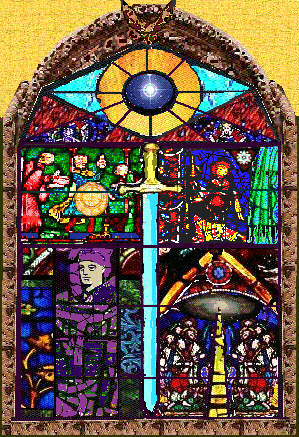 With a flourish better suited to a masque, the King's
General drew his blade and advanced to the edge.
With a flourish better suited to a masque, the King's
General drew his blade and advanced to the edge.
"You know full well," said Xaltoran, "that your
communication was not a matter of state."
Falk concentrated on the Lady Kaihima, now making her way
towards the dais.
A triumphant smile played about Frostmane's lips. "Then
surely a private audience would have been more appropriate
than this. Could it be that the desire to daunt me with a
great display of arms overruled all other
considerations?"
The crowd grew more restive. Open discontent with the
proceedings flared. Prominent nobles gathered to form
conspiratorial groups.
Lord Nissuraj glanced again at Kaihima. This time, the
meaning of her signal, a hand lifted vertical, was obvious.
With ill-concealed relief, the King's General returned to
his original position and stance.
Xaltoran said: "There are times when a ruler must seek no
counsel save his own. The conscience of a king is sacred,
inviolable."
"And so is his duty to defend his realm," Starkad
countered.
Kaihima reached the dais and climbed without hesitation to
the third step.
"So, King Starkad," she said, her voice mocking,
challenging. "Your sword is now, if only metaphorically,
out of its scabbard. The threat is clear. The people of
Erastor will not fail to answer it."
"Has your king been struck dumb?" Starkad wondered.
"I know that I speak with his authority, and with the full
consent of those assembled."
There followed a roar of approval, echoing to the high
vault.
The Masked King said nothing.
Starkad whirled to confront the milling, murmuring
throng.
"How can you believe in a king who fears to speak? A
king who fears to show his face?"
A silence like that after thunder followed Starkad's
outburst. Instantly, he realized his mistake. He had hoped
to erode the people's faith in their lord. Instead, he had
polarised and intensified their instinctive distrust and
fear of himself, a stranger and potential enemy.
While the soldiers remained impassive (for which condition
the praetorians were especially suited) the courtiers hurled
abuse at Frostmane.
Starkad tried to speak again; but his voice was soon drowned
in yelps of anger, issuing from all parts of the chamber.
Disdaining further attempts at making himself heard, he
signalled his intention to leave. Secretly, he was not
displeased at this outcome: the northlander harboured
contempt for diplomacy, favouring solutions carved out by
steel, and treaties signed in blood.
Kaihima turned and walked up to the throne.
"I regret the necessity," she said quietly.
"Of course," Xaltoran replied, as if lost in
abstraction.
"I warrant this place hasn't seen a man like Starkad for a
thousand years or more." Kaihima's admiration was
obvious.
"I suspect," Falk muttered, "it'll see him again soon
enough."
Watching the Skarnyr lord's departure, Falk mused on the
outcome of the curious drama he had just witnessed.
Undoubtedly, Xaltoran had mishandled the confrontation, and
the hour should have belonged to Frostmane. If only the
young conqueror had learned to wield his tongue as well as
(Falk readily imagined) his sword. Once the anger of the
nobles had not been aroused - to them, any flagrant
reference to the king's disfigurement was grossly
distasteful, a breach of etiquette - any chance of inciting
them to doubt further their lord had been lost.
On balance, Falk concluded, the Lady Kaihima, with a little
audacity and a few stirring words, had managed to steal all
the glory.
Taunts, insults and derisive laughter ebbed as Starkad
progressed down the centre of the hall between the gleaming
ranks of soldiery. Feral light from his cerulean eyes
stabbed at the crowd, inspiring fear and respect. Without a
backward glance, he left the audience chamber and plunged
into the corridor beyond.
The armed statues, though peculiarly vigilant, allowed him
to pass.
Lord Nissuraj and three other men sat around a five-sided
table in a pentagonal room.
The high vault, walls, floor, table and chairs were all
coated with lacquer of the purest white, against which the
coloured robes and gemmed adornments of the occupants
clashed violently. Light from invisible sources permeated
the enclosed space, allowing no shadows to mar the albescent
planes and angles. A rectangular mirror filled the doorway,
reflecting the lineaments of the chamber with such flawless
clarity the illusion of an identical apartment beyond an
open arch was powerfully suggested.
An ebony longstaff rested in the corner opposite the door;
the skull of a horned rat, its eye-sockets inset with red
jewels, crowned the black shaft.
The four men fell silent and looked towards the arch as the
mirror slid sideways into the wall.
Lady Kaihima entered; the door closed behind her.
Without any word of greeting, she took her place at the
pentagonal table. The others waited for her to speak.
Before doing so, she looked intently at each of them in
turn. Her eyes, in the pure light of the room, appeared as
hard and brilliant as the emeralds in her necklace.
"I see that recent events have left their mark," she said
finally. "Perhaps now you'll agree the king is not fit to
rule."
"It's possible an explanation will be forthcoming," ventured
the man on her left, a totally hairless individual with
intricate black patterns inscribed upon all visible skin
surfaces.
"We drift perilously close to the maelstrom of treason,"
said another, nervously adjusting amber-tinted spectacles on
a somewhat inadequate nose.
"We did that when we formed this cabal," Kaihima pointed
out. "And that was two years ago. Without our clandestine
influence, the fabric of the state would be even more
threadbare than it is."
There were murmurs of agreement.
The King's General said, "Any reasonable monarch would
consult with advisers before making crucial decisions."
Kaihima pursued the point: "I need hardly remind any of you
that Xaltoran has never consulted the High Council, on any
issue whatsoever, during the course of his unfortunate
reign." With sweet sarcasm, she added, "Apparently, he
prefers to commune with metal familiars ... or perhaps his
chessmen are privy to state secrets."
Laughter ripped around and across the table.
"As to treason," proclaimed the hairless one, "that is
surely a crime committed against a kingdom, not a king.
Xaltoran's subreptive parleys with this barbarian Starkad,
which have brought us to the brink of war, surely qualify as
treason."
"Aye," Lord Nissuraj said. "Your argument is sound. But the
fighting men of Erastor will act as the king commands - he's
gained their favour by devising new weaponry. As King's
General, I'm little more than a cypher."
Kaihima leaned forward, her face rigid with conviction.
"All this is true. But the fact remains that only we here
can save Erastor now. Our fellow nobles will pirouette to
destruction without a thought, albeit with a suitable degree
of patrician disdain. I don't know how much time we have.
Very little, I suspect. The situation now arising is
outside all previous knowledge and experience. Erastor
faces a crisis unique in recent times. Even the age-old
threat from Challun-Tioch seems illusory by comparison."
She scanned the faces of her fellow conspirators. "Are we
agreed, at least, on this?"
They were.
Pressing home the advantage, Kaihima said, "It's obvious
that Starkad will have little use for the tactics of delay.
When he strikes, it'll be soon, and with the determination
to pursue his chosen course to the finish. In the event of
war, we must act swiftly to depose Xaltoran, then establish
an immediate truce."
She placed her hands palms down on the white table.
The others followed suit without hesitation.
Kaihima sighed.
"We've forged broad policy only," Lord Nissuraj cautioned.
"A detailed plan is bound to prove more tasking."
"As you might expect," Kaihima deftly responded, "I've
already given this some thought. It's essential, first, to
undermine Xaltoran's authority. The only way of
guaranteeing this is to cast certain doubt - is that a
paradox? - on his right to the throne. I believe this is
not only possible, but readily achieved."
She turned towards the councillor seated to her right: an
unusually tall individual, robed in grey velvet, who had
kept silent throughout the meeting.
Kaihima said, "You know what must be done."
The man rose from his seat, bowed, took the longstaff from
its corner, then moved swiftly to the door.
As the grey councillor left the pentagonal chamber, Kaihima
smiled enigmatically. "Checkmate, I think."
"The king is dead," Nissuraj intoned. "Long live the
queen?"
"That is a decision for the High Council," Kaihima demurred.
"I would not, even as Xaltoran's only extant blood relative,
presume to an automatic claim."
"How fortunate," Nissuraj murmured, "that the late King
Jethuran proved impotent in so many crucial ways." Then he
was struck by another thought. "Have you ever known such a
predicament? We're about to have a war - at least, we must
proceed on that assumption - and none of us understands the
cause."
"I've the strangest feeling," Kaihima said, "that Xaltoran
and Starkad have crossed swords in the past ... that this is
a personal conflict, and the rest of us have no choice but
to be drawn into it."
"Nonsense!" It was the shaven-headed one. "There's no
mystery here. Starkad is a barbarian, a pirate. All he
seeks in Erastor is plunder. The purpose of the audience
was to gauge our strength. Xaltoran was a fool to agree to
it. At least, that's the general consensus."
"And surely this creature Falk is Starkad's spy," the
bespectacled man contended. "What's our policy regarding
him?"
Kaihima's eyes narrowed. "I would not have him killed," she
said slowly. "But it may prove unavoidable."
Ulainn sat alone in her cabin aboard the
Rimedawn.
Her mind full of turbulence, she sought peace in solitude
and the gentle motion of the galley. Anyone else would be
able to shut out visual distractions by the simple expedient
of closing eyelids; for the Skarnyr princess this was, of
course, impossible.
She had long accepted that her life would never be one of
calm and quiet. Her rare ability ensured this. As did the
path of conquest her brother followed with iron
determination.
Ulainn never forgot that her gift (a word she found
mordantly amusing) had partly stimulated Frostmane's vaunted
ambition. Her wild talent constituted a potent weapon, and
Starkad endeavoured to wield it as effectively as he did a
sword or an axe or a phalanx of warriors.
She loved her brother. Yet his obsessive dream of an empire
spreading over the world from the north like the inexorable
glaciers of an ice-age frequently terrified her. Being
Skarnyr, she was accustomed to conflict, but saw it as
rooted in the hostile conditions of her homeland. However,
she accepted her status in the game of kings with a degree
of fatalism.
In the most vivid, she had seen Falk standing in the depths
of a great forest, on a road gleaming like steel under a
misted sun, with a noctivagant rider approaching on a
spectral steed.
The comparisons between Falk and her brother were obvious
and tempting - black wolf set beside tawny, eagle beside
hawk - and she wondered if Falk, too, might be a prize to be
wrested from Erastor.
Chimeric barriers falling like stormwood across the many
paths of the future rendered the outcome uncertain.
Ulainn knew only that Falk faced dangers beyond those of the
immediate present. If the gold-eyed warrior survived
Erastor, there were other forces ready to destroy him. Two
were stark clear, as if lit by flares.
First, the Hunters of Challun-Tioch, potential foes along a
distinct branch of futurity. The Hunters were no strangers
to Ulainn. They had prowled often the deepest,
shadow-haunted recesses of her mental labyrinth. Ulainn was
unaware, however, that Falk had already witnessed the climax
of one of their sacred rites: that if the Hunters knew
nothing of him, Falk understood at least a little of
them.
With Erastor conquered, Starkad intended to advance on
Fallen Moon and waken and whelm the power that slept there;
but even the war-loving Frostmane did not relish conflict
with the Hunters.
The second force threatening Falk, though a single
individual, was even more potent than the first, for it
shared Falk's fountainhead (a source Ulainn had not yet
discovered) and followed him, hungrily, out of the past.
A lone hunter, a man whose hands shone and flowed like
quicksilver. If swords had souls, then such a soul did this
man possess. If steel could think, then this man thought
like steel. If dreams could freeze, then this man's dreams
would freeze the heart of a sun.
A war-horn sounded.
The mirror of ice in possession of Ulainn's mind shattered.
Stars fell through blackest night.
She whispered, "It begins."
 Forward